Most people do not spend much time thinking about their constitutional rights—until they suddenly find themselves in a police encounter.
Whether it happens during a traffic stop, a neighborhood investigation, or an unexpected interaction in public, emotions tend to run high. Unfortunately, many people misunderstand how their rights actually work and unintentionally make mistakes that can complicate a situation.
Understanding a few basic legal principles beforehand can make a meaningful difference when interacting with law enforcement.


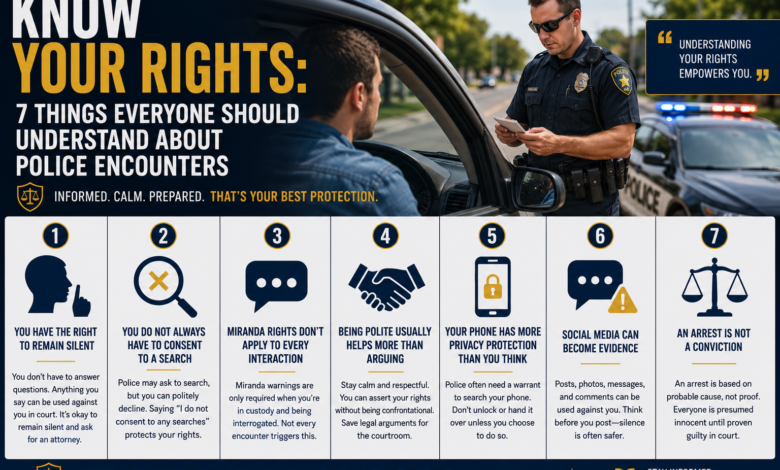
Here are seven important things everyone should understand about police encounters.
1. You Have the Right to Remain Silent
One of the most important constitutional protections is the right against self-incrimination.
Many people mistakenly believe staying silent makes them look guilty. In reality, the right to remain silent exists to protect everyone—including innocent people.
Stressful situations often lead people to say things they later regret. Nervousness, confusion, or poor wording can easily be misunderstood.
A respectful statement such as:
“I would like to remain silent and speak with an attorney.”
is often far safer than trying to explain everything in the moment.
Remaining silent is not the same thing as being disrespectful.
2. You Do Not Always Have to Consent to a Search
Many people believe they are legally required to say “yes” if police ask permission to search their car, backpack, or belongings.
That is not always true.
There is an important difference between:
A lawful search, and
A request for consent.
If an officer asks, “Do you mind if I take a look?” that may be a request—not a legal command.
People generally have the ability to politely decline consent in many circumstances.
A calm response like:
“I do not consent to any searches.”
can preserve important legal protections without escalating the interaction.
3. Miranda Rights Do Not Apply to Every Police Interaction
Television has created a major misconception about Miranda rights.
Many people think officers must immediately read rights anytime police ask questions.
That is not how it works.
Miranda warnings are generally required when:
- A person is in custody, and
- Police are conducting interrogation likely to produce incriminating responses.
For example, a routine traffic stop or casual interaction may not automatically trigger Miranda requirements.
This distinction surprises many people.
4. Being Polite Usually Helps More Than Arguing
Police encounters can feel frustrating or unfair.
Still, roadside arguments rarely improve the situation.
Even when someone believes officers are mistaken, confrontational behavior may unintentionally escalate tensions.
This does not mean giving up rights.
People can respectfully decline searches, remain silent, and avoid answering questions while still remaining calm and professional.
There is a difference between asserting rights and creating conflict.
Legal disputes are generally handled later—in court, not on the roadside.
5. Your Phone Has More Privacy Protection Than You Think
Modern smartphones contain enormous amounts of personal information:
- Text messages
- Photos and videos
- Emails
- Banking information
- Search history
- Location data
- Social media accounts
Because phones contain so much private information, courts often treat cellphone searches differently than ordinary property.
In many situations, law enforcement may need a warrant before reviewing a phone’s contents.
Importantly, voluntarily unlocking or handing over a phone may sometimes change the legal analysis significantly.
Consent matters.
6. Social Media Can Become Evidence
Many people underestimate how often online activity becomes part of criminal investigations.
Posts, photos, videos, comments, text messages, and private messages may later become evidence.
Even posts intended as jokes or emotional reactions can be taken out of context.
Statements such as:
- “Crazy night!”
- “Worth it.”
- “The cops totally overreacted.”
may later be viewed differently in a legal setting.
When legal issues arise, less online discussion is often the safer choice.
7. An Arrest Does Not Mean Someone Is Guilty
Many people assume an arrest automatically means prosecutors have overwhelming evidence.
Not necessarily.
An arrest generally requires probable cause, which is a much lower standard than proving guilt in court.
Criminal charges still must be proven beyond a reasonable doubt.
Evidence may later be challenged.
Witnesses may contradict one another.
Legal defenses may exist.
An arrest starts the legal process—it does not determine the outcome.
Final Thoughts
Police encounters are stressful, and misunderstandings about constitutional rights are incredibly common.
Understanding basic legal principles before an encounter happens can help people make smarter decisions, avoid unnecessary mistakes, and better protect themselves.
Knowing when to speak, when to remain silent, when consent matters, and how privacy rights work can make a meaningful difference.
In stressful moments, informed decisions are often the most valuable protection a person has.
Most people do not spend much time thinking about their constitutional rights—until they suddenly find themselves in a police encounter.
Whether it happens during a traffic stop, a neighborhood investigation, or an unexpected interaction in public, emotions tend to run high. Unfortunately, many people misunderstand how their rights actually work and unintentionally make mistakes that can complicate a situation.
Understanding a few basic legal principles beforehand can make a meaningful difference when interacting with law enforcement.
Here are seven important things everyone should understand about police encounters.
1. You Have the Right to Remain Silent
One of the most important constitutional protections is the right against self-incrimination.
Many people mistakenly believe staying silent makes them look guilty. In reality, the right to remain silent exists to protect everyone—including innocent people.
Stressful situations often lead people to say things they later regret. Nervousness, confusion, or poor wording can easily be misunderstood.
A respectful statement such as:
“I would like to remain silent and speak with an attorney.”
is often far safer than trying to explain everything in the moment.
Remaining silent is not the same thing as being disrespectful.
2. You Do Not Always Have to Consent to a Search
Many people believe they are legally required to say “yes” if police ask permission to search their car, backpack, or belongings.
That is not always true.
There is an important difference between:
A lawful search, and
A request for consent.
If an officer asks, “Do you mind if I take a look?” that may be a request—not a legal command.
People generally have the ability to politely decline consent in many circumstances.
A calm response like:
“I do not consent to any searches.”
can preserve important legal protections without escalating the interaction.
3. Miranda Rights Do Not Apply to Every Police Interaction
Television has created a major misconception about Miranda rights.
Many people think officers must immediately read rights anytime police ask questions.
That is not how it works.
Miranda warnings are generally required when:
- A person is in custody, and
- Police are conducting interrogation likely to produce incriminating responses.
For example, a routine traffic stop or casual interaction may not automatically trigger Miranda requirements.
This distinction surprises many people.
4. Being Polite Usually Helps More Than Arguing
Police encounters can feel frustrating or unfair.
Still, roadside arguments rarely improve the situation.
Even when someone believes officers are mistaken, confrontational behavior may unintentionally escalate tensions.
This does not mean giving up rights.
People can respectfully decline searches, remain silent, and avoid answering questions while still remaining calm and professional.
There is a difference between asserting rights and creating conflict.
Legal disputes are generally handled later—in court, not on the roadside.
5. Your Phone Has More Privacy Protection Than You Think
Modern smartphones contain enormous amounts of personal information:
- Text messages
- Photos and videos
- Emails
- Banking information
- Search history
- Location data
- Social media accounts
Because phones contain so much private information, courts often treat cellphone searches differently than ordinary property.
In many situations, law enforcement may need a warrant before reviewing a phone’s contents.
Importantly, voluntarily unlocking or handing over a phone may sometimes change the legal analysis significantly.
Consent matters.
6. Social Media Can Become Evidence
Many people underestimate how often online activity becomes part of criminal investigations.
Posts, photos, videos, comments, text messages, and private messages may later become evidence.
Even posts intended as jokes or emotional reactions can be taken out of context.
Statements such as:
- “Crazy night!”
- “Worth it.”
- “The cops totally overreacted.”
may later be viewed differently in a legal setting.
When legal issues arise, less online discussion is often the safer choice.
7. An Arrest Does Not Mean Someone Is Guilty
Many people assume an arrest automatically means prosecutors have overwhelming evidence.
Not necessarily.
An arrest generally requires probable cause, which is a much lower standard than proving guilt in court.
Criminal charges still must be proven beyond a reasonable doubt.
Evidence may later be challenged.
Witnesses may contradict one another.
Legal defenses may exist.
An arrest starts the legal process—it does not determine the outcome.
Final Thoughts
Police encounters are stressful, and misunderstandings about constitutional rights are incredibly common.
Understanding basic legal principles before an encounter happens can help people make smarter decisions, avoid unnecessary mistakes, and better protect themselves.
Knowing when to speak, when to remain silent, when consent matters, and how privacy rights work can make a meaningful difference.
In stressful moments, informed decisions are often the most valuable protection a person has.